Tikal History and Ancient Maya Civilization Facts
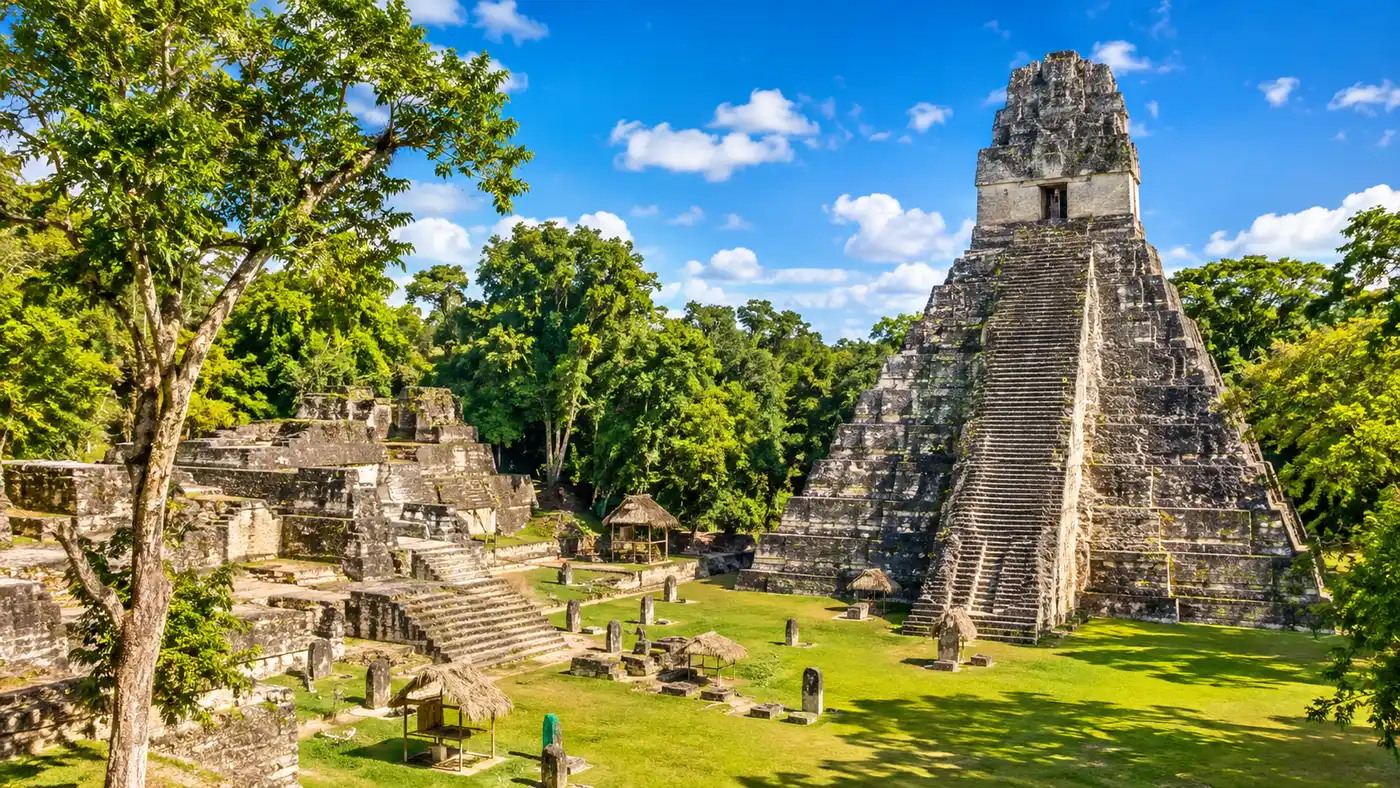
You hear the jungle before you see anything built by human hands. Deep in the Petén basin of northern Guatemala, howler monkeys roar through a thick morning fog that smells of damp earth and rotting leaves. Then, suddenly, a 150-foot limestone prow pierces the green canopy right in front of you. Understanding tikal history requires grappling with this exact collision between relentless tropical nature and breathtaking human ambition, because this city was once the beating economic and military heart of the Mesoamerican lowlands.
Walking the modern paths today, it feels peaceful, almost quiet if you ignore the birds. But during the Classic Period, this was an astonishingly loud, bustling metropolis filled with painted plaster, shouting merchants, smoke from cooking fires, and royal courts issuing edicts across Central America. To help you appreciate what stands beneath the moss, let us unpack the deep chronicle of this ancient superpower, the rulers who shaped it, and the real reasons it melted back into the Petén forest.
Book your tikal tours experience:
What Was Tikal and Who Built It?
If you ask an archaeologist to define Tikal, they will describe a sprawling Classic Maya capital that dominated trade routes, warfare, and cultural innovation across Mesoamerica for nearly a millennium. But what was Tikal originally called by the people who lived there? Inscriptions chiseled onto limestone stelae tell us its ancient name was Yax Mutal, which roughly translates to "First Green Sprout" or "First Hair Knot." The modern word Tikal is generally believed to come from the Itza Maya language, with the tikal meaning loosely translated as "at the waterhole" or "place of voices." For travelers trying to get the tikal pronunciation right, stress falls firmly on the second syllable: tee-KAHL.
People often ask: how old is Tikal, and when was Tikal built? The earliest village traces date back to around 900 BC, during the Middle Preclassic period. These early farmers cleared small swaths of jungle, planted maize, and slowly terraced hillsides. By 300 BC, monumental architecture began taking shape. Who built Tikal Guatemala into an imperial center was not a single conqueror, but rather a dynastic line of more than 33 recorded monarchs belonging to the ancient maya civilization Tikal reverence. The dynasty claimed descent from Yax Ehb Xook, a founding ruler who lived in the first century AD, establishing a royal bloodline that endured for centuries through brutal wars, internal coups, and foreign interventions.
This was never an isolated fortress. The maya city of Tikal was an epicenter of trade, gathering jade from the Motagua River valley, volcanic obsidian from the highlands, quetzal feathers from cloudy ridges, and salt from coastal lagoons. Maya Tikal became wealthy because it sat on an overland passage linking the Gulf of Mexico with the Caribbean coast. Controlling this movement meant controlling the ancient Maya world.
Note: Most hieroglyphs at the site refer to the royal emblem glyph for Mutal, shaped like a tied bundle of hair. If you see the name "Tikal" in older history books, remember that no ancient resident would have recognized that word.
The Golden Age of the Largest Mayan City
By the sixth century AD, the mayan city of Tikal had evolved into arguably the largest mayan city of its era. Urban planners estimate that the central urban district covered roughly 16 square kilometers, with rural satellite suburbs sprawling outward over 57 square kilometers. While Rome had aqueducts, the engineers of tikal city relied entirely on sophisticated rainwater management. They engineered enormous reservoirs, carving out former limestone quarries and sealing the bedrock with impermeable clay plaster, ensuring tens of thousands of citizens survived the punishing four-month annual dry season.
Tikal history changed forever on January 16, 378 AD. Hieroglyphic monuments record the arrival of a foreign warlord named Siyaj K'ak', hailing from the massive central Mexican metropolis of Teotihuacan. On that exact day, the local king of Tikal, Chak Tok Ich'aak I, "entered the water" - a poetically chilling Maya phrase for his death. Siyaj K'ak' installed a new pro-Mexican dynasty on the throne, led by a boy-king named Yax Nuun Ahiin I. This Teotihuacan arrival infused the city with foreign weapons, feather-draped war imagery, and brand new religious doctrines, turning the kingdom into an aggressive military empire.
Every superpower has a rival, and for the tikal mayan state, that rival was Calakmul, a giant city situated 100 kilometers north in modern Campeche, Mexico. For over a century, the two giants fought a proxy war that dragged dozens of smaller city-states into the fray. In 562 AD, Calakmul defeated Tikal in a catastrophic conflict known to historians as the "Tikal Hiatus." For roughly 130 years, Tikal erected almost no carved monuments. Its population languished. Many assumed the kingdom was finished.
Then arrived Jasaw Chan K'awiil I. Taking the throne in 682 AD, this brilliant strategist revitalized the army, strengthened farm output, and in 695 AD ambushed and captured Calakmul's supreme lord, Yuknoom Yich'aak K'ahk'. That triumph ignited a construction frenzy that transformed the skyline into what you see on postcards today.
| Period | Approximate Dates | Estimated Core Population | Major Historical Milestone |
|---|---|---|---|
| Middle Preclassic | 900 BC – 300 BC | Under 2,500 | Early agricultural clearing, humble clay platforms |
| Late Preclassic | 300 BC – 250 AD | 10,000 – 25,000 | First major temples raised in the North Acropolis |
| Early Classic | 250 AD – 550 AD | 35,000 – 50,000 | Arrival of Teotihuacan warriors; military expansion |
| Middle Classic (Hiatus) | 562 AD – 682 AD | Stagnant / dropping | Defeat by Calakmul; complete construction pause |
| Late Classic (Peak) | 682 AD – 850 AD | 60,000 – 90,000 | Jasaw Chan K'awiil defeats Calakmul; towering pyramids built |
| Terminal Classic | 850 AD – 950 AD | Under 1,000 | Systemic drought, civic abandonment, jungle reclamation |
What Did Tikal Look Like at Its Peak?
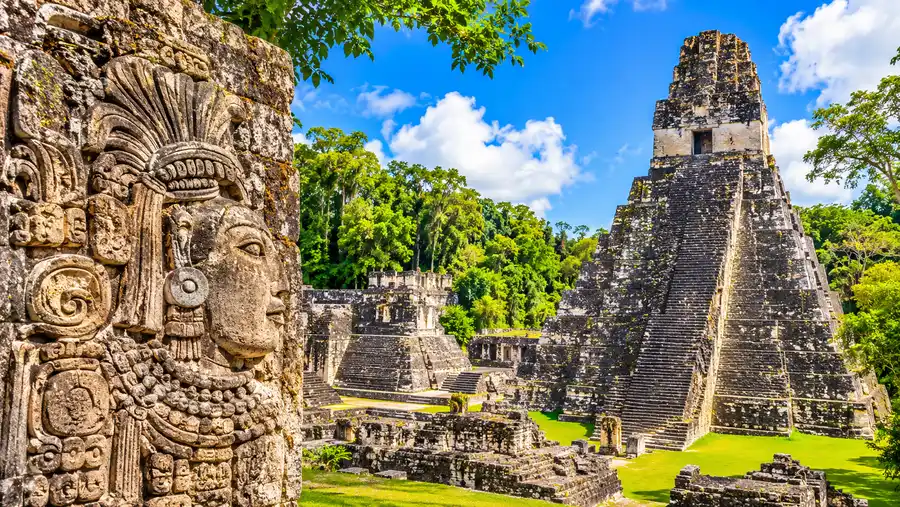
Close your eyes and strip away the vines, the trees, and the gray weathering on the stones. What did Tikal look like in 750 AD? It was shockingly colorful, clean, and surprisingly urban. The pyramids were not bare gray rock. They were coated in thick layers of polished stucco painted deep vermilion red, bright yellow, and brilliant white. Sculpted masks representing jaguar gods and celestial serpents glared down from palace friezes, outlined in rich blues and charcoal blacks.
The ground beneath your feet was not dirt. Huge limestone-paved causeways, called sacbeob, connected far-flung architectural complexes. These raised roads measured up to 80 feet wide and functioned as ceremonial highways and defensive channels during seasonal storms. Crowds filled the Great Plaza, trading salt cakes, textiles, caged macaws, chili peppers, and sweet cacao beans, which served as actual currency. Smoke from copal resin drifted across the plazas day and night, filling the city with a sweet pine scent that masked the smell of thousands of people packed together.
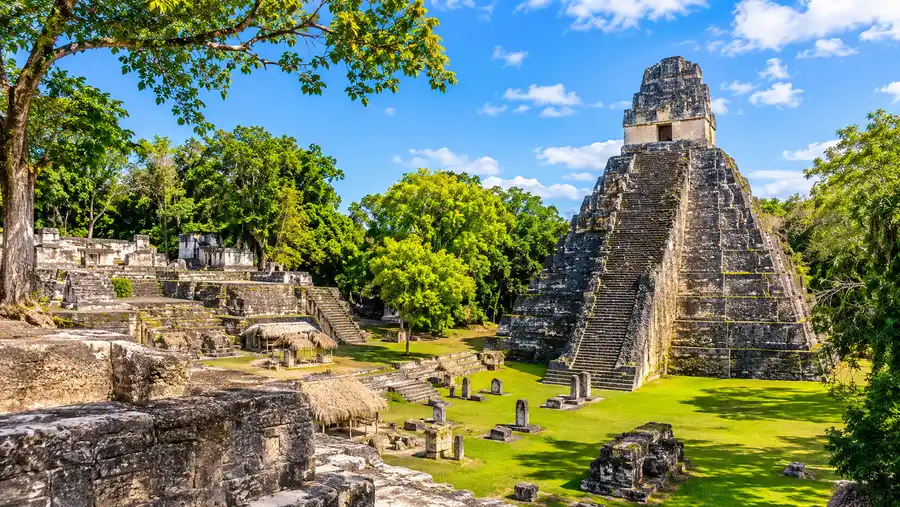
Those iconic, razor-steep pyramids were royal funerary shrines rather than hollow temples. For instance, Temple I, towering 154 feet over the Great Plaza, was built specifically to seal the burial chamber of Jasaw Chan K'awiil I. If you want a detailed breakdown of how each structure functioned, our guide to the Tikal temples and pyramids covers the architecture room by room. Directly opposite stands Temple II, constructed for his wife, Lady Kalomt'e K'abel. These structures were literal machines for ancestor veneration, engineered to elevate dead kings directly into the heavenly realm where their spirits could lobby the rain gods on behalf of the living.
Pro tip: Walk around the back side of Temple V early in the morning. The forest floor slopes downward there, exposing the original hydraulic canal system that directed runoff into the palace reservoirs.
Book your tikal tours experience:
The Mystery of the Collapse and Why Tikal Was Abandoned
By the ninth century, the gears of the city ground to an agonizing halt. The last dated hieroglyphic monument carved at Tikal carries a date corresponding to 869 AD, raised by a lesser-known king named Jasaw Chan K'awiil II. Within three generations, the population collapsed, palaces were looted, and the Great Plaza filled with wild shrubs. Why did the mayan civilization Tikal collapse so quickly after reaching its pinnacle?
Historians long debated single-cause explanations, like peasant rebellions or foreign invasions. Modern sediment core samples from nearby Lake Petén Itzá tell a more nuanced story of environmental catastrophe brought on by human overuse:
- Severe Mega-Droughts: Climatological data shows northern Central America endured four brutal multi-year droughts between 800 AD and 910 AD, hitting a city entirely dependent on rainfall reservoirs.
- Aggressive Deforestation: Producing the plaster required to coat a single large pyramid demanded burning hundreds of acres of mature timber for lime kilns, devastating local weather cycles.
- Mercury and Toxic Algal Blooms: Recent geochemical studies found that Tikal's two main central drinking reservoirs had toxic levels of mercury, leached directly from the cinnabar paint the royal elite used to decorate palaces.
- Destructive End-Stage Warfare: As clean water and arable land shrank, conflicts between regional cities turned from ritual elite captures to desperate wars of resource extermination.
It didn't last. The survivors simply walked away. They scattered northward into the Yucatán or southward into river valleys where freshwater still flowed year-round. Monkeys and strangler figs moved in, roots cracked open the lime plaster, and the city disappeared from historical memory for centuries.
Fascinating Tikal Facts and Modern Rediscovery
Local Indigenous hunters never completely forgot that ruins existed deep in the bush, but the outside world remained oblivious until March 1848. That year, Modesto Méndez, the governor of Petén, led an official expedition to document the towering mounds, accompanied by artist Eusebio Lara. When Méndez climbed the crumbling stairs of Temple I, he left an inscription recording his visit, introducing the ancient ruins in Guatemala to global science.
Tikal National Park facts reveal how unique this place remains today. Established in 1955, it spans 222 square miles of protected subtropical forest, recognized by UNESCO in 1979 as one of the few World Heritage sites preserved simultaneously for both cultural and ecological reasons. Tapirs, pumas, and over 400 species of birds live alongside the tombs of forgotten monarchs.
- Star Wars Yavin 4: George Lucas used the view from the top of Temple IV looking east toward Temples I, II, and III as the Rebel Alliance base in the 1977 film Star Wars: Episode IV - A New Hope.
- Thousands of Unexcavated Mounds: Despite decades of work by the University of Pennsylvania, more than 70% of ancient ruins in Guatemala within the park boundary remain completely buried beneath jungle soil.
- A King Buried with Jewels: When archaeologists tunneled into the tomb inside Temple I, they discovered Jasaw Chan K'awiil I draped in over 180 carved jade beads and holding an inscribed jaguar bone.
- LiDAR Scans Changed Everything: In 2018, airborne laser mapping revealed tens of thousands of hidden structures, defensive ditches, and raised agricultural fields around Tikal, proving the regional population was three times larger than previously believed.
Honestly, the sheer scale of the ruins can feel disorienting. You walk for 20 minutes down an ordinary dirt path thinking you are in pristine untouched wilderness, then you notice the steep hill beside you has squared edges and cut stones poking out from the dirt. You are never walking through wild forest here. You are walking across the roof of an enormous, buried city.
Frequently Asked Questions about tikal history
Why was Tikal so important to the Mayans?
Tikal held immense religious and political power because it controlled trade corridors connecting the Caribbean, the Gulf of Mexico, and the volcanic highlands. Its kings claimed ancient royal ancestry and successfully allied with or conquered dozens of neighboring Maya city-states.
Who built Tikal?
Tikal was built by the ancient Maya people across more than a millennium, guided by an unbroken dynastic sequence of at least 33 kings. The most iconic temples standing today were commissioned by Late Classic rulers, particularly Jasaw Chan K'awiil I and his son Yik'in Chan K'awiil.
How old is Tikal?
The earliest known farmsteads at Tikal date to around 900 BC, making the human settlement nearly 3,000 years old. Monumental stone architecture began around 300 BC, and the city reached its height between 600 AD and 850 AD.
What caused the fall of Tikal?
A combination of recurring regional droughts, massive deforestation, overpopulation, and polluted drinking reservoirs starved the city of resources. As royal authority collapsed under the environmental stress, the population scattered by 900 AD.
Quick Reference
- Founded around 900 BC, abandoned by 900 AD
- Original ancient Maya name was Yax Mutal
- Peak population estimated between 60,000 and 90,000
- Site of the Rebel Base in the 1977 Star Wars film
- Over 3,000 ancient structures mapped in the central zone
Book your tikal tours experience:
Walking Through the Past Today
Standing in the center of the Great Plaza as the afternoon sun casts long shadows from Temple I, you realize how quickly empires fade when their natural systems fracture. Tikal was not an idyllic woodland settlement. It was a dense, concrete-paved imperial capital that pushed its environment to the absolute edge and lost the gamble. When you plan your trip, set aside at least four or five hours to explore without a rigid schedule. Sit on the stone terraces of the Central Acropolis, listen to the parrots, and give yourself space to absorb the ghosts of this mighty city.
Read more about tikal tours.